Wiccan Symbolism, Rituals & Mysticism
Living on the West Coast, I've had the opportunity to meet people from an extraordinary variety of spiritual backgrounds. Some attend churches, others meditate in Zen centres, some practice yoga, and others identify as Pagan or Wiccan. One thing I've learned is that while the outward forms of religion may differ dramatically, many traditions are asking similar questions about our place in the universe, the rhythms of life, and what it means to live well. Wicca is one of the younger organised religions, having emerged publicly during the mid-twentieth century, yet many of its symbols and rituals draw inspiration from much older European folklore, ceremonial magic, and pre-Christian traditions. To understand Wicca, it is helpful to set aside popular stereotypes and instead appreciate its emphasis on nature, seasonal cycles, personal responsibility, and the sacredness of life itself.
Wicca is often described as a nature-based religion. Unlike many faiths that place their greatest emphasis upon sacred texts or historical events, Wiccan spirituality finds much of its inspiration in the changing seasons, the movements of the Moon, the fertility of the Earth, and humanity's relationship with the natural world. Rather than seeing nature merely as the backdrop to spiritual life, Wiccans generally regard it as one of its primary expressions. Forests, rivers, mountains, animals, and the changing weather are not simply environmental features; they become reminders of life's continual cycles of birth, growth, decline, death, and renewal.
One of the first things many people notice about Wicca is its symbolic emphasis upon fertility. Here, however, the word "fertility" deserves careful explanation because modern readers often associate it exclusively with sexuality. Within Wiccan thought, fertility is understood much more broadly. It refers to the generative forces of life itself, the continual emergence of new ideas, new relationships, new harvests, new opportunities, and new beginnings. Seeds germinate, animals reproduce, forests regenerate after fires, and human creativity continually produces art, music, inventions, and communities. Fertility therefore symbolises the universe's remarkable capacity for renewal.
This emphasis creates an interesting contrast with some other religious traditions. For example, within Christianity, one of the central mysteries surrounding the birth of Jesus is the doctrine of the Virgin Birth, in which the conception of Jesus is understood as a miraculous act of the Holy Spirit rather than ordinary human reproduction. The emphasis falls upon divine intervention rather than biological fertility. Sexuality itself receives relatively little attention in the biblical narratives surrounding Jesus' birth, and the theological focus rests upon incarnation, salvation, and God's relationship with humanity. Wicca approaches sacred symbolism from a different direction. Rather than downplaying fertility, it often celebrates the creative processes found throughout the natural world as expressions of the sacred.
Importantly, this should not be misunderstood as reducing Wicca to sexuality. Popular media has sometimes sensationalised Wiccan practices by focusing disproportionately upon fertility symbolism while ignoring the religion's broader ethical and spiritual dimensions. For most contemporary Wiccans, fertility encompasses creativity, abundance, growth, healing, imagination, emotional flourishing, and the continual renewal of life itself. Human sexuality represents one aspect of this larger creative principle, but it is by no means the whole picture.
Central to many Wiccan traditions is the symbolic relationship between the Goddess and the God. Different Wiccan traditions interpret these figures in different ways. Some understand them as distinct deities, while others see them as symbolic expressions of complementary aspects of a single divine reality. The Goddess is frequently associated with the Moon, intuition, nurturing, wisdom, and the cycles of life, while the God is often connected with the Sun, forests, wildlife, vitality, and seasonal change. Their symbolic relationship reflects balance and interdependence rather than competition.
This idea of complementary balance appears repeatedly throughout Wiccan symbolism. Light and darkness, summer and winter, growth and rest, masculine and feminine energies, activity and contemplation all participate within the natural rhythm of existence. Unlike philosophical systems that divide reality into absolute opposites of good versus evil, Wicca generally emphasises balance. Winter is not regarded as evil simply because plants become dormant. It represents a necessary stage within the larger cycle that eventually gives rise to spring.
Wicca & The Pentacle
The pentacle is perhaps the best-known symbol associated with Wicca. It consists of a five-pointed star enclosed within a circle. Contrary to common misconceptions, the pentacle is not inherently associated with evil or malevolent forces. Within Wiccan symbolism, the five points often represent the classical elements: earth, air, fire, water, and spirit. The surrounding circle symbolises unity, wholeness, protection, and the interconnectedness of creation. Together, these elements express the idea that humanity exists in harmonious relationship with the natural world rather than standing apart from it.
The four classical elements occupy an important place in Wiccan ritual. Earth symbolises stability, abundance, and physical wellbeing. Air represents intellect, communication, and inspiration. Fire reflects energy, transformation, courage, and creativity. Water symbolises emotion, intuition, healing, and compassion. During rituals, these elements may be represented symbolically through stones, incense, candles, and bowls of water, reminding participants that human life depends upon the harmonious interaction of natural forces.
Many Wiccan ceremonies begin with the casting of a circle. To outsiders this may appear mysterious, but its symbolism is both practical and spiritual. The ritual circle creates sacred space, a temporary environment set apart from ordinary daily concerns. Rather than functioning as a magical barrier in the popular imagination, many practitioners understand it as a symbolic boundary encouraging mindfulness, focus, and reverence. Much as churches, temples, or meditation halls invite a different quality of attention, the ritual circle helps participants enter a reflective state of mind.
The Wiccan Wheel of the Year
The annual cycle of festivals, known collectively as the Wheel of the Year, forms another cornerstone of Wiccan practice. These eight Sabbats mark significant points within the agricultural and seasonal calendar. Samhain honours ancestors and the completion of the harvest. Yule celebrates the winter solstice and the gradual return of light. Imbolc welcomes the first signs of spring, while Ostara celebrates renewal and balance at the spring equinox. Beltane, perhaps the festival most strongly associated with fertility, celebrates the flourishing of life and the abundance of late spring. Litha marks the summer solstice, Lughnasadh honours the first harvest, and Mabon celebrates the autumn equinox and the gathering of the final harvest.
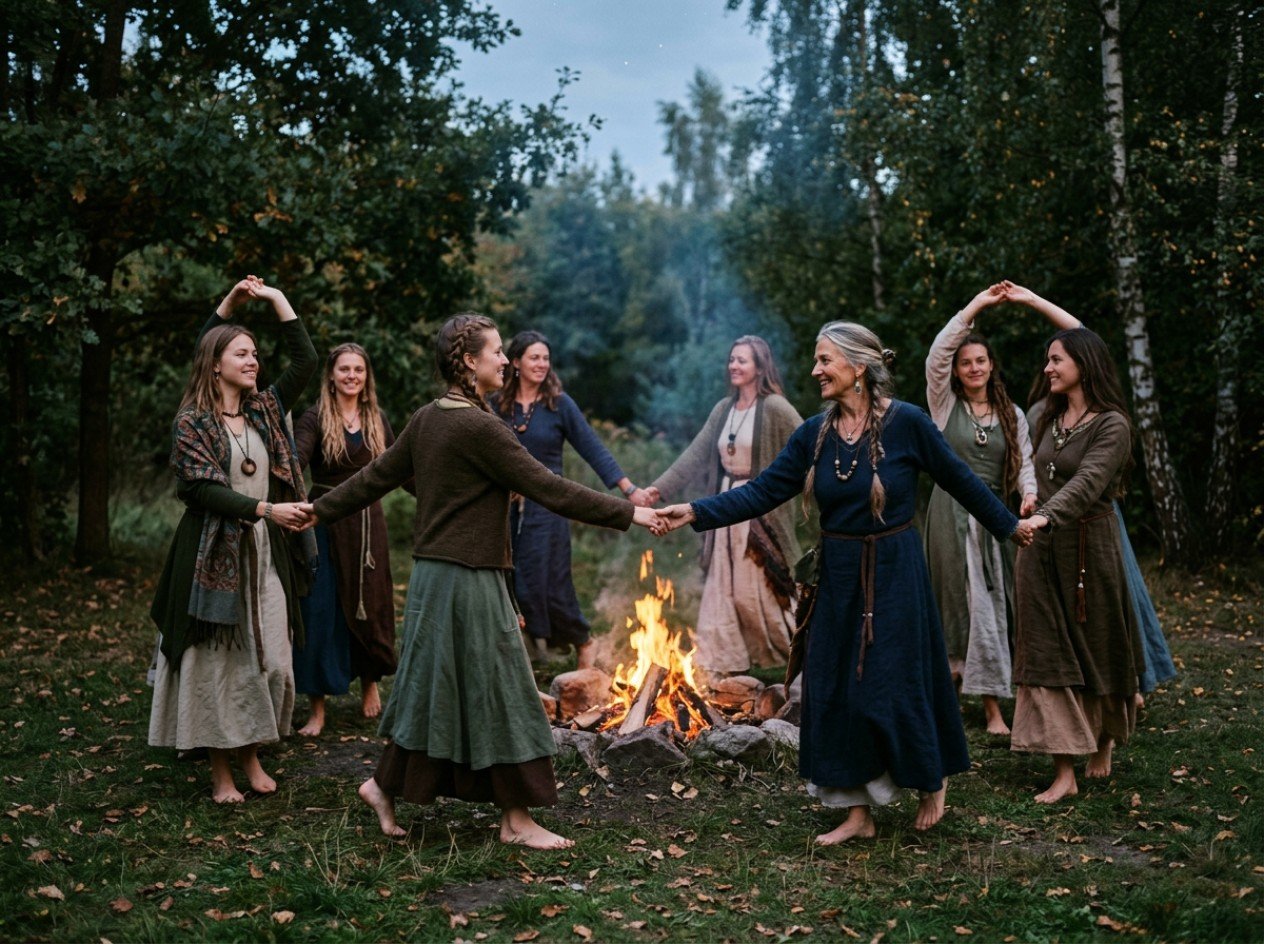
Beltane deserves special attention because it is frequently misunderstood. Traditionally celebrated around the beginning of May, Beltane symbolises the fertility of the Earth, the blossoming of nature, and the abundance of life. Historical customs included bonfires, dancing, music, flowers, and community celebrations. While some historical sources describe symbolic representations of fertility, modern Wiccan celebrations vary widely and are generally family-friendly community events focused upon gratitude, seasonal renewal, and connection with nature rather than the sensationalised portrayals sometimes found in popular culture.
The Moon also occupies a central place within Wiccan ritual life. Many practitioners observe Esbats, ceremonies held during the Full Moon or occasionally the New Moon. The Moon symbolises intuition, emotional awareness, reflection, and the cyclical nature of existence. Watching the Moon wax, become full, wane, and disappear before beginning anew reminds practitioners that human lives also move through changing seasons. Difficult periods eventually give way to renewal, just as winter gradually yields to spring.
Wicca & Magic
Magic, another aspect frequently misunderstood, generally occupies a symbolic and intentional role within Wicca. Most practitioners understand magical work less as supernatural spectacle and more as the focused direction of intention, attention, and symbolic action toward meaningful goals. Candles, herbs, crystals, written affirmations, and ritual gestures become physical expressions of hope, healing, gratitude, protection, or personal transformation. Whether interpreted psychologically or spiritually, these practices encourage mindfulness and deliberate reflection rather than passive wishing.
Ethics remain central to Wiccan spirituality. One widely quoted principle is the Wiccan Rede: "An it harm none, do what ye will." Although interpreted differently among practitioners, it encourages careful consideration of the consequences of one's actions. Closely related is the concept often called the Threefold Law, suggesting that our actions—whether kind or harmful—ultimately return to influence our own lives. Whether understood literally or symbolically, these teachings encourage personal responsibility rather than fear of divine punishment.
Nature itself functions as perhaps Wicca's greatest sacred text. While many religions derive authority primarily from scripture, Wicca often encourages learning directly from observation of the natural world. The changing seasons teach impermanence. Forests demonstrate resilience. Rivers illustrate continual movement. Gardens reveal the importance of patience and care. These everyday experiences become opportunities for spiritual reflection without requiring separation from ordinary life.
One of the strengths of Wiccan symbolism is its accessibility. One need not identify as Wiccan to appreciate many of its underlying insights. The importance of gratitude, environmental stewardship, seasonal awareness, mindfulness, and living harmoniously with nature resonates across many religious and secular worldviews. Even those who do not share Wiccan theological beliefs may find value in its invitation to observe the natural rhythms that continue shaping human life despite our increasingly technological world.
It is also important to acknowledge the diversity that exists within modern Wicca. Gardnerian, Alexandrian, Dianic, Eclectic, and numerous other traditions each possess distinctive practices and emphases. There is no single governing authority determining universal doctrine. Individual covens and solitary practitioners often adapt rituals according to personal experience while maintaining respect for the broader principles of the religion.
Ultimately, Wiccan symbolism and ritual invite participants to recognise the sacredness of life's continual cycles. Fertility, properly understood, becomes far more than biological reproduction. It symbolises the astonishing creativity woven throughout existence, the growth of forests, the return of spring, the birth of ideas, the healing of relationships, and the capacity for continual renewal. While Christianity and Wicca emphasise different theological themes, one centring many of its foundational narratives upon divine revelation and salvation, the other finding profound spiritual meaning in nature's cycles and creative abundance, both seek, in their own distinctive ways, to help people understand their place within a larger sacred reality. Appreciating these differences thoughtfully allows us to better understand not only Wicca itself but also the remarkable diversity through which human beings have sought meaning, purpose, and connection across the centuries.