The Use of Tarot in Jungian Psychology
Certainly. I’d keep the same **seven-paragraph structure and substance**, but loosen the prose a little—more of Elliot thinking aloud, a few natural asides, less textbook-like phrasing, and more variation in sentence rhythm.Carl Jung & Tarot: The Psychology Hidden in the Cards
I should probably start with a small clarification, because Carl Jung's name gets attached to Tarot so often that you could easily assume he spent half his career studying the cards. He didn't. Jung was certainly interested in symbolism, astrology, alchemy, divination and the I Ching, and he was far more willing than many psychologists of his generation to wander into areas that didn't fit neatly within conventional psychology. He also made occasional references to Tarot. But there isn't a great Jungian book on the Major Arcana sitting somewhere waiting to be rediscovered. For me, the connection is actually more interesting than that. Tarot seems to provide, almost by accident, a visual language for many of the things Jung spent his life thinking about. Look through the Major Arcana and you find the mother, the ruler, the wise old man, the innocent traveller, the shadow, temptation, love, death, destruction, renewal and eventual completion. We've encountered these characters before, even if we've never touched a Tarot deck. They're in myths, fairy tales, religions, films and dreams. They're the kinds of recurring human patterns that fascinated Jung. That's why I think Tarot and Jung sit so comfortably beside one another. We don't have to pretend Jung secretly decoded the cards to recognize that they're exploring much of the same territory.
Jung was born in Switzerland in 1875 and, famously, worked closely with Sigmund Freud before the two men went their separate ways. Their disagreement was about much more than personality. Freud generally looked toward childhood, repression, sexuality and the personal experiences that help create our unconscious lives. Jung thought there was something deeper going on. He kept noticing that remarkably similar images appeared in myths, religions and dreams belonging to people separated by geography, culture and sometimes thousands of years. Eventually this helped lead him towards his idea of the "collective unconscious": a deeper psychological inheritance shared by humanity. Within it were what Jung called archetypes, fundamental patterns that repeatedly find expression through different images and stories. Pick up a Tarot deck and it's difficult not to see the connection. Consider The Hermit. An elderly figure stands alone holding a lamp in the darkness. We can look at him simply as an old man on a card, but most of us instinctively recognize something more. He's the solitary seeker, the wise elder, the person who steps away from ordinary life because there is something he needs to understand. We've met him countless times before. The Empress carries something of the mother and creator; The Emperor embodies authority and order; The Fool is the innocent traveller taking the first step into an unknown world. What interests me isn't whether these cards have one "correct" Jungian meaning. It's why we recognize these figures at all.
The card I probably find most useful when thinking about Jung is The Moon. Jung devoted a great deal of attention to what he called the "shadow"—those parts of ourselves that don't fit comfortably with the person we like to believe we are. If I see myself as calm, generous and reasonable, I'm probably not going to be terribly enthusiastic about acknowledging my jealousy, selfishness, anger or irrationality. So I push those qualities away. The problem is that unwanted parts of the personality don't politely disappear because we've decided not to look at them. They have a habit of turning up elsewhere—in dreams, compulsions, projections and sometimes in the people who irritate us far more than they reasonably should. Now look at the Rider-Waite-Smith Moon card. It's a wonderfully strange image: darkness, a path disappearing into the distance, a dog and a wolf, water, and a creature crawling up from beneath the surface. We can see the landscape, but not properly. Everything is half revealed. That's remarkably close to the experience of encountering something unconscious. I don't think Pamela Colman Smith was secretly illustrating Jungian psychology, and we should be careful about reading history backwards. Rather, both Tarot and Jung were drawing upon much older symbolic associations. Darkness, deep water, wild animals and uncertain paths were metaphors for the unknown parts of ourselves long before psychologists started giving those experiences technical names.
Then there's Jung's idea of "individuation", which I think is one of those psychological terms that has been softened over time into something rather nicer than Jung intended. It's sometimes described as "becoming your true self," which makes it sound like a particularly successful wellness retreat. Individuation is considerably messier than that. It's the process of becoming psychologically more whole, and becoming whole means meeting parts of ourselves we'd much rather leave outside. We have to distinguish the "persona"—the version of ourselves we present to other people—from the much larger and more contradictory personality underneath it. We have to encounter the shadow. We have to accept that maturity doesn't necessarily mean eliminating our contradictions. Seen from that perspective, the Major Arcana begins to look remarkably like a journey through a human life. The Fool sets out knowing very little. Along the way we encounter authority in The Emperor, tradition in The Hierophant, relationship and choice in The Lovers, solitude in The Hermit, surrender in The Hanged Man, transformation in Death, temptation in The Devil, catastrophe in The Tower and, eventually, a kind of integration in The World. I wouldn't claim that the Major Arcana is secretly a coded map of Jung's individuation process. It isn't. But as a modern way of working with the cards, the comparison is enormously useful. Instead of asking, "What's going to happen to me?" we can ask, "Where am I in this journey?" For me, that's a much more interesting question.
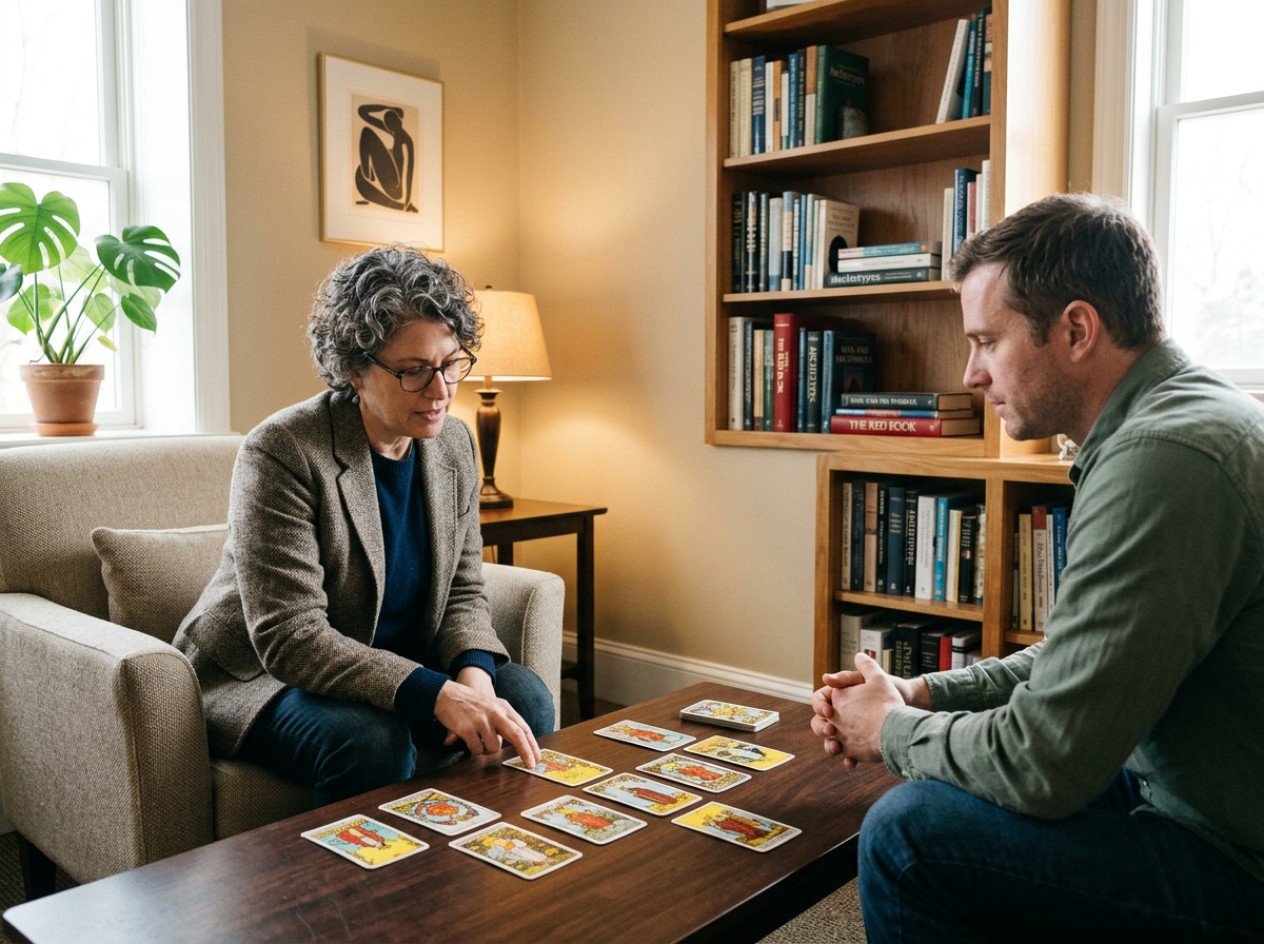
This also explains why I sometimes think the card we don't want to draw can be more revealing than the one we hoped for. Imagine asking about a relationship and turning over The Devil. It's very easy to panic. Is somebody being unfaithful? Is the relationship toxic? Is something terrible about to happen? A Jungian approach slows the whole thing down. Before deciding what the card predicts, notice what it does to you. Why did that image immediately make you uncomfortable? What are you frightened it might mean? Where do attachment, dependency, temptation, jealousy or control exist in the situation you're asking about? Perhaps they don't describe the relationship at all. Perhaps the card has touched something you're already carrying into it. The same can happen with apparently positive cards. The Sun might make one person feel hopeful and another strangely exposed. The Emperor can represent security to somebody who values structure and feel suffocating to someone with painful experiences of authority. I wouldn't describe Tarot as a psychological test—the evidence simply isn't there to make that claim—but it can work rather well as a prompt for projection and reflection. Give the mind an ambiguous image and it starts filling in the spaces. What we notice first can sometimes be revealing. I've always liked the idea that the Tarot card doesn't necessarily need to tell us something. Sometimes its real purpose is to make us tell ourselves something.
Jung's fascination with "synchronicity" brings us even closer to the actual experience of using Tarot. Jung used synchronicity to describe meaningful coincidences where an inner psychological experience and an external event seem connected even though we can't identify an ordinary chain of cause and effect between them. His thinking developed partly through his engagement with the I Ching and through his conversations with the physicist Wolfgang Pauli. Anyone who has used Tarot regularly will recognize the experience immediately. You shuffle seventy-eight cards, pull one apparently at random and find yourself staring at an image that seems almost absurdly appropriate to the question you've just asked. I've had this happen often enough to understand why people find it uncanny. Does that prove something supernatural happened? No. It could involve probability, selective attention, projection or our very human talent for finding meaningful patterns. Or perhaps, as Jung suggested with synchronicity, meaningful coincidence deserves to be considered in its own right. I'm quite comfortable leaving some of that unresolved. If I'm wondering whether I need to step away from a situation and I draw The Hermit, the card has suddenly given me a symbolic way of thinking about the problem. I don't actually need to decide whether the universe deliberately handed me The Hermit for the encounter to matter. That's one of the things I appreciate about Jung. He was prepared to take an experience seriously without immediately forcing it into one of two boxes marked "supernatural" and "meaningless."
And perhaps that's where Jung and Tarot finally come together for me. Jung gives us a way of taking symbolic experience seriously without requiring us to abandon critical thought. A Tarot deck contains kings and queens, lovers and hermits, suns and moons, angels and devils, falling towers, wheels, stars, death and resurrection. We can dismiss all of this as picturesque old symbolism, or we can insist that the cards literally know what's going to happen next Tuesday. I don't find either position particularly satisfying. Jung suggests a third possibility: symbols matter because human beings are symbolic creatures. We dream in images. We tell stories about ourselves. We use metaphor constantly, often without noticing we're doing it. Someone can know perfectly well that Death in Tarot doesn't usually mean literal death and still feel a slight jolt when that skeletal rider appears on the table. That reaction is interesting. What am I frightened of losing? What has already ended that I'm refusing to acknowledge? What version of myself am I trying to keep alive after I've outgrown it? The Tower can ask what structure in my life is less secure than I've pretended. The Star can ask what hope remains after something falls apart. The World can ask what completion actually looks like. None of those questions requires Tarot to predict tomorrow. They're questions about today. And that, I think, is where Jung and Tarot meet most convincingly. Both start from the rather unsettling idea that there are parts of ourselves we don't completely understand, and that an image can occasionally reach somewhere ordinary language can't. The cards don't necessarily contain our answers. Sometimes their real value lies in showing us the questions we've been carefully avoiding.