
The Hierophant In Tarot Card Readings
The Hierophant Tarot Card: Symbolism, Meaning & Interpretation
Of all the figures in the Major Arcana, The Hierophant is one I think modern readers are particularly inclined to misunderstand. The Fool feels adventurous, The Magician powerful, The Lovers romantic and The Hermit wonderfully introspective. The Hierophant, by comparison, can look rather institutional. In the familiar Rider-Waite-Smith deck, he sits between two pillars dressed in elaborate religious robes, his right hand raised in blessing while two followers kneel before him. At his feet are crossed keys. Everything about the scene suggests hierarchy, ceremony, teaching and established authority. For someone who approaches Tarot as a personal spiritual practice, that can feel strangely restrictive. Aren't we supposed to discover truth for ourselves? The Hierophant replies with a slightly uncomfortable question: where did you learn what "yourself" means in the first place? None of us begins with a completely blank spiritual or psychological page. We inherit stories, customs, moral assumptions, rituals, symbols and ways of understanding the world. Even when we reject them, we're responding to something that came before us. The Hierophant is therefore much more interesting than simply "organized religion." He represents tradition, certainly, but also transmission—the process through which knowledge, belief and meaning pass from one person or generation to another. His appearance in a reading can ask us what we've inherited, whom we've chosen to learn from and whether the structures surrounding us still deserve our trust.
The name itself tells us something. "Hierophant" comes from Greek roots referring to the revealing or showing of sacred things, and historically the title is particularly associated with the Eleusinian Mysteries of ancient Greece. Earlier Tarot traditions usually called this card The Pope, or Il Papa, which makes sense within the overwhelmingly Christian culture of Renaissance Italy in which the early Tarot decks developed. Modern decks have broadened the figure considerably, sometimes presenting him as a priest, teacher, elder, spiritual guide or keeper of tradition. I actually think "Hierophant" is a useful name because it shifts our attention away from one particular religious office and towards a much older human role: the person who introduces others to sacred knowledge. Every culture has had people who perform some version of this function, although we should be cautious about treating very different religious roles as though they're interchangeable. What matters symbolically is the relationship between knowledge and transmission. The Hermit goes away alone to discover something. The Hierophant stays within the community and teaches what has been preserved. That's an important distinction. Mysticism is often presented today as intensely individual—my path, my intuition, my truth—but human spirituality has rarely existed entirely in isolation. Someone preserved the stories. Someone remembered the ritual. Someone taught the prayer, painted the symbol, copied the manuscript or explained what happened at a particular point in a ceremony. The Hierophant reminds us that spiritual knowledge has a history.
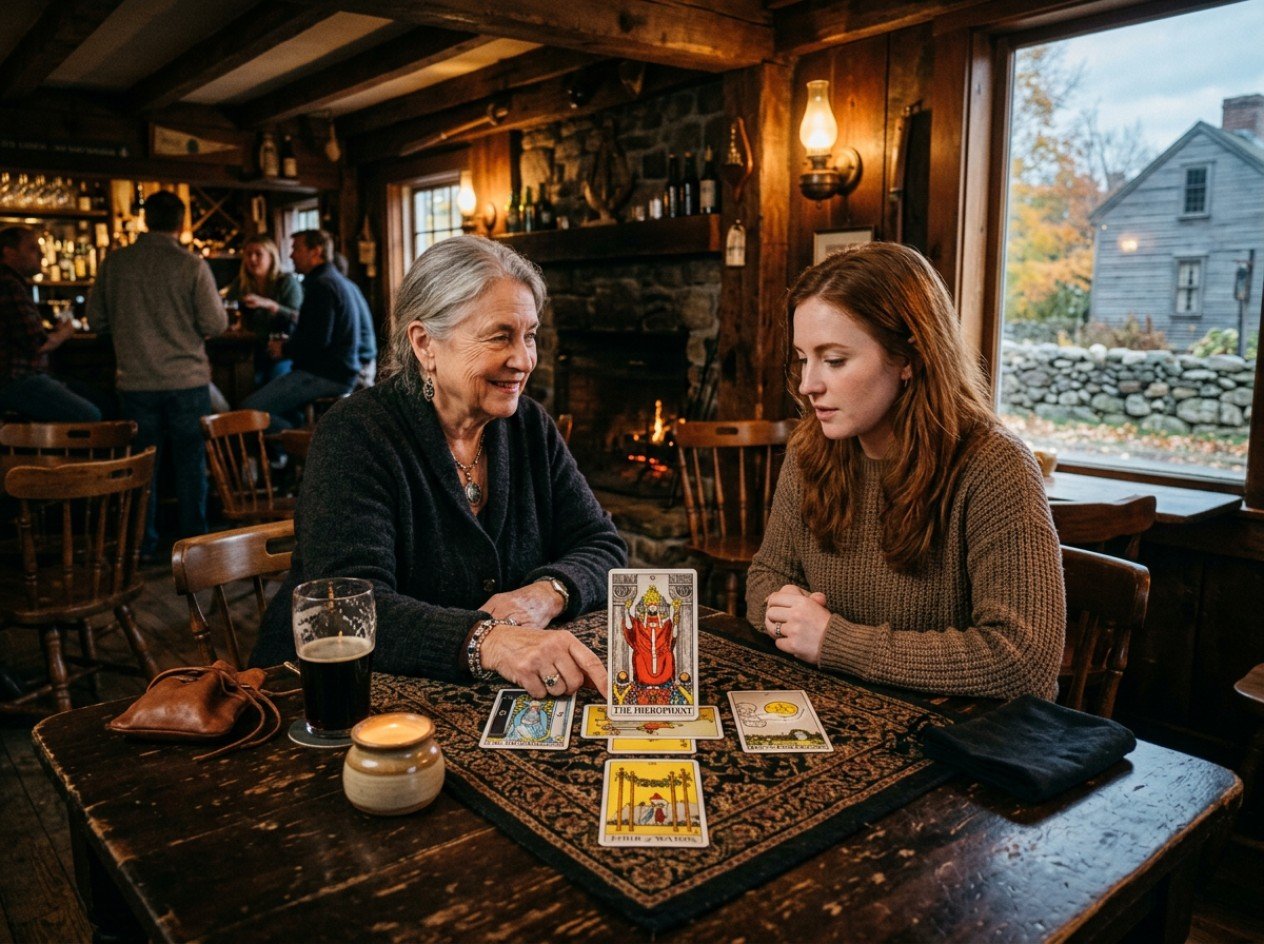
The Rider-Waite-Smith imagery reinforces this idea beautifully. The Hierophant sits between two pillars, creating the impression that we're looking into a sacred or ceremonial space. His triple crown and layered vestments emphasize spiritual office rather than personal celebrity; he represents a role larger than the individual occupying it. His raised hand offers a blessing, while the two fingers pointing upward and two downward can be read as suggesting a relationship between different levels of existence—the spiritual and material, the unseen and the visible. At his feet lie two crossed keys, traditionally associated in Christian symbolism with the keys of Saint Peter and therefore with spiritual authority and access. In front of him kneel two figures whose clothing is decorated with flowers, commonly read as roses and lilies, images that can suggest desire and purity, passion and disciplined intention. What interests me most, however, is the simple fact that there are students present. The Magician stands alone. The High Priestess sits alone. The Emperor rules alone. The Hierophant's identity makes sense only because somebody is learning from him. This is a card about relationship: teacher and student, institution and member, tradition and inheritor. When it appears, I sometimes ask a very simple question: who taught you this? It can be surprisingly revealing. We carry beliefs about love, success, morality, gender, family, spirituality and even happiness that we may never have consciously chosen. Somewhere along the way, somebody handed us the keys.
This is why I don't automatically interpret The Hierophant as either positive or negative. Tradition can be enormously valuable. I'm originally from Scotland, and perhaps that makes me particularly aware of the strange emotional power carried by customs, places, stories and rituals that existed long before we did. There's something deeply human about participating in an action knowing that generations before you performed something similar. Tradition can give us roots. A good teacher can save us years of wandering around making unnecessary mistakes. A community can preserve wisdom no individual could realistically rediscover alone. But institutions can also become more concerned with preserving themselves than preserving truth. Teachers can become authoritarian. Customs can continue long after anyone remembers why they began. "We've always done it this way" is sometimes an expression of accumulated wisdom and sometimes an excellent description of a problem. The Hierophant therefore asks us to develop discernment rather than obedience. If the card appears when you're considering education, it might point toward formal study, mentorship or learning within an established system. In a spiritual reading, it may suggest engaging more deeply with a tradition rather than continually sampling new ones. In a relationship reading, it can indicate commitment, shared values or conventional structures such as marriage. But it can also ask whether you're following a particular relationship script simply because you've been told that's what a successful life is supposed to look like.
There's another aspect of The Hierophant that I think has become particularly relevant in the modern world: our complicated relationship with expertise. We live in an age in which almost any piece of information can be found within seconds, and that can create the illusion that information and knowledge are the same thing. They aren't. Reading ten paragraphs online about Kabbalah doesn't make someone a Kabbalist. Watching three videos on astrology doesn't provide the same understanding as years spent studying charts. Knowing the definitions of Tarot cards isn't necessarily the same as knowing how to read them well. The Hierophant represents the uncomfortable but important idea that some forms of understanding require discipline, patience and instruction. That's not a fashionable message because we quite reasonably distrust gatekeeping and unnecessary hierarchy. Yet the opposite extreme has its problems too. If everyone becomes their own unquestionable authority, how do we distinguish insight from misunderstanding? The Hierophant sits in that tension. He asks us to respect knowledge without worshipping the person who possesses it. Find teachers, but don't surrender your judgement to them. Learn the rules before deciding which ones need breaking. Study the tradition before claiming to have improved it. I find this particularly important in mysticism, where it's remarkably easy to take an ancient symbol out of context, give it a completely modern interpretation and then confidently describe that interpretation as something people have believed for thousands of years.
When The Hierophant appears reversed, or when we encounter what we might call the shadow side of the card, these questions become even sharper. The reversed Hierophant is often interpreted as rebellion against convention, rejecting authority, questioning inherited beliefs or finding an unconventional spiritual path. Sometimes that's exactly what's needed. There are moments in life when the institution no longer deserves our loyalty, the teacher has stopped teaching us, or the rules we've inherited prevent rather than encourage growth. But rebellion can become every bit as automatic as obedience. I've met people who reject an idea almost entirely because it's traditional, which gives tradition just as much control over them as unquestioning conformity would. If you automatically do the opposite of what authority tells you, authority is still determining your behaviour. A reversed Hierophant can therefore ask whether we're genuinely thinking for ourselves or simply defining ourselves through opposition. It can also warn about false teachers, rigid dogma, hypocrisy or the misuse of spiritual authority. In a relationship, perhaps two people are rejecting conventional expectations and creating something that suits them better. Or perhaps one partner is discovering that supposedly "traditional values" are being used to control them. Context matters enormously. The card doesn't tell us that institutions are bad any more than its upright position tells us institutions are good. It asks us to examine our relationship with them.
Ultimately, I think The Hierophant occupies an essential place in the Major Arcana because sooner or later every genuine spiritual journey encounters the question of authority. Who do I believe? Which traditions do I inherit? Which do I question? What should I learn before attempting to discover things entirely for myself? The Fool begins the Tarot journey with almost no experience, and that innocence is beautiful, but innocence alone can't carry us very far. At some point we need teachers, books, traditions, communities and ideas that have survived longer than we have. Then, equally importantly, we have to decide what we're going to do with what we've been taught. That's why I don't see The Hierophant as a card telling us to conform. I see him sitting at the doorway between inherited wisdom and personal understanding. He hands us the keys, but he doesn't necessarily tell us which door to open. Perhaps that's the real meaning of the card. We don't become wise by blindly accepting everything the past gives us, nor by arrogantly assuming the past has nothing to teach us. We listen. We study. We question. We test what we've inherited against experience. And eventually, if we're fortunate, something that began as somebody else's teaching becomes knowledge we've genuinely made our own. The Hierophant reminds us that finding our own path doesn't always mean walking alone. Sometimes it begins by sitting down, for a while, and learning from someone who has already travelled part of the road.