


Zoroastrian Mysticism
When students first encounter Zoroastrianism, they are often surprised to learn that it is one of the world's oldest continuously practised religions. Founded in ancient Persia, probably sometime between 1500 BCE and 1000 BCE—although scholars continue to debate the precise dates—it has profoundly influenced the development of later religious traditions, including Judaism, Christianity, and Islam. Concepts such as the cosmic struggle between good and evil, the importance of moral choice, angels, the final judgement, and the renewal of the world all find significant expression within Zoroastrian thought. Yet beyond its historical importance lies another fascinating dimension that receives considerably less attention: its mystical tradition. Although Zoroastrianism is not generally associated with mysticism in the same way as Kabbalah, Sufism, or Christian contemplative spirituality, it nevertheless contains a rich spiritual philosophy concerned with inner transformation, divine wisdom, and humanity's relationship with the sacred order of creation.
As with many ancient religious traditions, it is important to distinguish between theology and mysticism. Theology concerns itself primarily with doctrines, beliefs, and religious teachings. Mysticism, by contrast, explores the direct experience of the sacred. Mystics seek not merely to understand God intellectually but to cultivate a deeper awareness of divine reality through contemplation, ethical living, prayer, and personal transformation. In the case of Zoroastrianism, mystical thought developed less through formal monastic traditions than through reflection upon the teachings of the prophet Zarathustra, known to the Greeks as Zoroaster—and the symbolic language of the sacred texts.
The Role of Zarathustra
Zarathustra occupies a unique position in religious history. According to Zoroastrian tradition, he experienced profound revelations from Ahura Mazda, whose name may be translated as "Wise Lord." Rather than presenting a collection of magical rituals or secret techniques, Zarathustra proclaimed a vision centred upon wisdom, truth, justice, and moral responsibility. His teachings are preserved most directly within the Gathas, a collection of poetic hymns forming part of the Avesta, the sacred scripture of Zoroastrianism. These hymns remain among the oldest surviving religious texts in the world and continue to shape Zoroastrian belief today.
At the heart of Zoroastrian spirituality stands Ahura Mazda, understood not simply as a powerful deity among many others but as the supreme source of wisdom, goodness, truth, and creation itself. Unlike some mystical traditions that emphasise the unknowable nature of the divine, Zoroastrianism presents Ahura Mazda as both transcendent and intimately involved with creation. Human beings are invited into a relationship with divine wisdom through ethical living, thoughtful reflection, and conscious participation in the ongoing struggle between truth and falsehood.
Asha & Druj
This brings us to one of the defining concepts within Zoroastrian thought: Asha. The word is difficult to translate with complete precision because it carries several related meanings simultaneously. It refers to truth, righteousness, order, harmony, justice, and the fundamental pattern according to which the universe operates. Asha represents the moral and cosmic order established by Ahura Mazda. Living according to Asha therefore involves much more than following religious rules. It means aligning one's thoughts, words, and actions with the deepest principles governing both ethical life and the structure of reality itself.
Opposed to Asha is the concept of Druj, usually translated as falsehood, deception, disorder, or chaos. The relationship between Asha and Druj is often misunderstood as a simple battle between equal opposing forces. Classical Zoroastrian theology generally does not present them as equally powerful principles. Rather, truth ultimately possesses enduring reality, while falsehood represents a distortion that human beings possess both the freedom and responsibility to resist. Mystically interpreted, this struggle unfolds not only within the external world but also within every individual heart.
One of the best-known summaries of Zoroastrian ethics is the phrase "Good Thoughts, Good Words, Good Deeds." In the original Avestan language these are expressed as Humata, Hukhta, and Hvarshta. At first glance the teaching appears remarkably simple. Yet from a mystical perspective it describes an integrated path of spiritual transformation. Thoughts shape speech. Speech influences action. Repeated actions gradually form character. Spiritual development therefore begins not merely with outward behaviour but with the cultivation of inner awareness. Long before modern psychology emphasised the importance of thought patterns, Zoroastrian wisdom recognised the intimate relationship between the mind and ethical conduct.
This emphasis upon conscious choice distinguishes Zoroastrian mysticism from traditions that stress passive acceptance or withdrawal from the world. Human beings are regarded as active participants in creation rather than detached observers. Every decision contributes, however modestly, to strengthening either Asha or Druj. Daily life therefore acquires profound spiritual significance. Preparing a meal honestly, speaking truthfully, caring for one's family, conducting business fairly, or protecting the natural environment all become expressions of sacred responsibility.
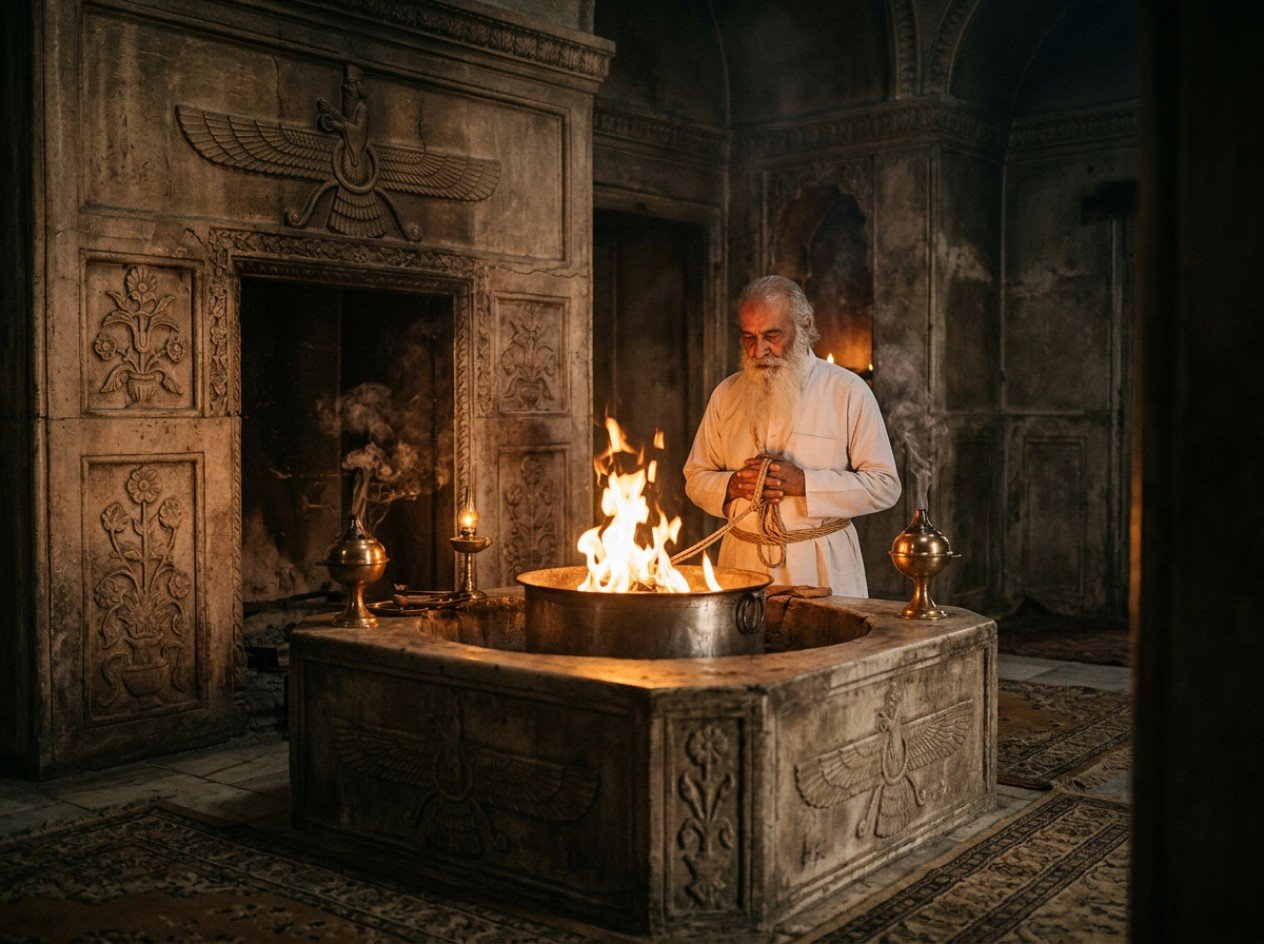
Fire occupies perhaps the most recognisable symbolic place within Zoroastrian worship. Outsiders have occasionally misunderstood this emphasis, assuming that Zoroastrians worship fire itself. In reality, fire functions as a symbol rather than an object of worship. Because fire gives light, warmth, and purification while remaining difficult to corrupt, it represents divine wisdom, truth, and the illuminating presence of Ahura Mazda. Within Zoroastrian temples, sacred fires are carefully maintained as visible reminders of the spiritual light toward which believers continually aspire. Mystically interpreted, the external flame also symbolises the inner light of conscience that guides moral decision-making.
Purity likewise plays an important role within Zoroastrian spirituality, although it should not be reduced merely to ritual cleanliness. Ancient Zoroastrian practices included careful attention to physical cleanliness, particularly concerning water, fire, and the natural elements. Beneath these rituals lies a deeper symbolic principle. Purity represents harmony with Asha—the continual effort to remove deception, selfishness, hatred, and moral confusion from one's life. External rituals therefore reinforce an inward commitment to spiritual integrity.
Nature itself holds considerable spiritual significance within Zoroastrian thought. Earth, water, air, plants, and animals are regarded as good creations worthy of respect because they originate from Ahura Mazda. Environmental responsibility therefore possesses theological as well as practical importance. Polluting rivers, wasting resources, or carelessly damaging creation violates not merely ecological principles but spiritual ones as well. In this respect, Zoroastrianism anticipates many contemporary discussions concerning environmental ethics and stewardship.
Prayer within Zoroastrian tradition serves not only as petition but also as spiritual alignment. Reciting sacred texts encourages believers to remember Asha while strengthening their commitment to living wisely. Like meditation in other contemplative traditions, regular prayer gradually shapes consciousness through repetition, attention, and reflection. Mystical spirituality often suggests that prayer changes the person praying as much as the circumstances for which they pray.
Another fascinating feature of Zoroastrian spirituality concerns the Amesha Spentas, often translated as the "Bounteous Immortals." These divine attributes or emanations represent qualities through which Ahura Mazda engages with creation. They include Wisdom, Truth, Devotion, Dominion, Wholeness, and Immortality. Although scholars debate their precise theological status, they function symbolically as ideals toward which human beings may aspire. Spiritual development therefore involves cultivating these divine qualities within one's own character.
The Process of Frashokereti
Zoroastrianism also possesses a hopeful understanding of history. Rather than viewing the world as trapped permanently within conflict, it anticipates the eventual triumph of Asha through the process known as Frashokereti, the final renewal or restoration of creation. Evil, suffering, and falsehood will ultimately be overcome as the universe reaches its intended fulfilment. Mystically understood, Frashokereti also reflects the possibility of continual renewal within individual lives. Every sincere act of goodness participates, however modestly, in the world's ongoing restoration.
Students frequently ask whether Zoroastrian mysticism resembles the mystical traditions of later religions. The answer is both yes and no. Unlike certain forms of mysticism emphasising ecstatic visions or withdrawal from society, Zoroastrian spirituality generally remains deeply engaged with ordinary life. Its mystical dimension expresses itself less through extraordinary experiences than through ethical transformation. One approaches the divine by becoming more truthful, compassionate, responsible, and wise. Daily conduct becomes the primary arena for spiritual growth.
Scholars have also noted interesting parallels between Zoroastrian concepts and later philosophical developments. The emphasis upon free will, moral responsibility, and the alignment of human consciousness with universal order resonates with themes found in Stoicism, Neoplatonism, and aspects of later Abrahamic spirituality. While direct historical influence remains complex and sometimes debated, Zoroastrian thought clearly participated in the broader intellectual and religious conversations of the ancient Near East.
Modern Zoroastrian communities, particularly the Parsis of India and Iranian Zoroastrians, continue preserving these ancient traditions while engaging thoughtfully with contemporary society. Despite being numerically small, they have made remarkable contributions to education, philanthropy, science, business, and public life. Their continued commitment to ethical responsibility reflects the enduring vitality of Zarathustra's original vision.
Perhaps the greatest lesson contemporary readers may draw from Zoroastrian mysticism is its insistence that spirituality cannot be separated from moral action. Mystical insight without ethical conduct remains incomplete. Every truthful conversation, every compassionate decision, every act of justice, every effort to care for the natural world becomes part of humanity's participation in Asha. In an age often characterised by misinformation, social division, and environmental uncertainty, this ancient emphasis upon truth, responsibility, and wisdom feels remarkably contemporary.
Zoroastrian mysticism reminds us that the deepest spiritual journey may not involve escaping the world but engaging it more faithfully. Through good thoughts, good words, and good deeds, individuals gradually align themselves with the divine order that sustains creation. Rather than seeking hidden knowledge available only to a select few, Zarathustra's teachings suggest that genuine wisdom is available through the continual practice of truth, compassion, integrity, and conscious choice. For students of comparative religion, this makes Zoroastrian mysticism not only historically significant but enduringly relevant—a quiet yet profound invitation to cultivate the inner light that allows both individuals and societies to flourish.