
Tarot & Mysticism
When students first encounter both mysticism and the Tarot, they often assume they belong naturally together. Modern books, websites, and films frequently present Tarot cards as mysterious tools capable of revealing hidden truths, while mysticism is portrayed as an equally mysterious search for spiritual knowledge. Although there is certainly a relationship between the two, it is rather more nuanced and interesting than popular culture sometimes suggests. Understanding that relationship requires us to appreciate both the history of the Tarot and the broader aims of mystical thought. Once we do so, we begin to see that the connection lies less in fortune-telling and more in symbolism, reflection, and personal transformation.
Let us begin by defining our terms. Mysticism refers to the pursuit of direct experience or deeper understanding of spiritual reality. Across cultures and religions, mystics have sought to move beyond the surface of everyday existence through contemplation, meditation, prayer, and self-examination. Rather than concentrating solely upon doctrine or intellectual knowledge, mysticism asks how individuals might experience a deeper sense of meaning, connection, or awareness. It is, in many respects, an inward journey.
The Tarot, by contrast, originated in fifteenth-century Europe as a card game. The earliest surviving decks from northern Italy were beautifully illustrated playing cards commissioned by wealthy families rather than mystical objects. It was not until the eighteenth century that writers in France began proposing that the cards contained ancient esoteric wisdom. Although many of these historical claims have since been challenged by scholars, the symbolic richness of the Tarot proved remarkably adaptable. During the nineteenth and twentieth centuries, it became closely associated with Western esoteric traditions, ceremonial magic, psychology, astrology, and mysticism.
This historical distinction is important because it reminds us that the Tarot did not begin life as a mystical system. Rather, mystics and esoteric thinkers recognised that the cards possessed a remarkable symbolic vocabulary capable of expressing profound human experiences. It was the symbolism, rather than the original purpose of the cards, that made them attractive as tools for contemplation and spiritual reflection.
Tarot Imagery & Mysticisim
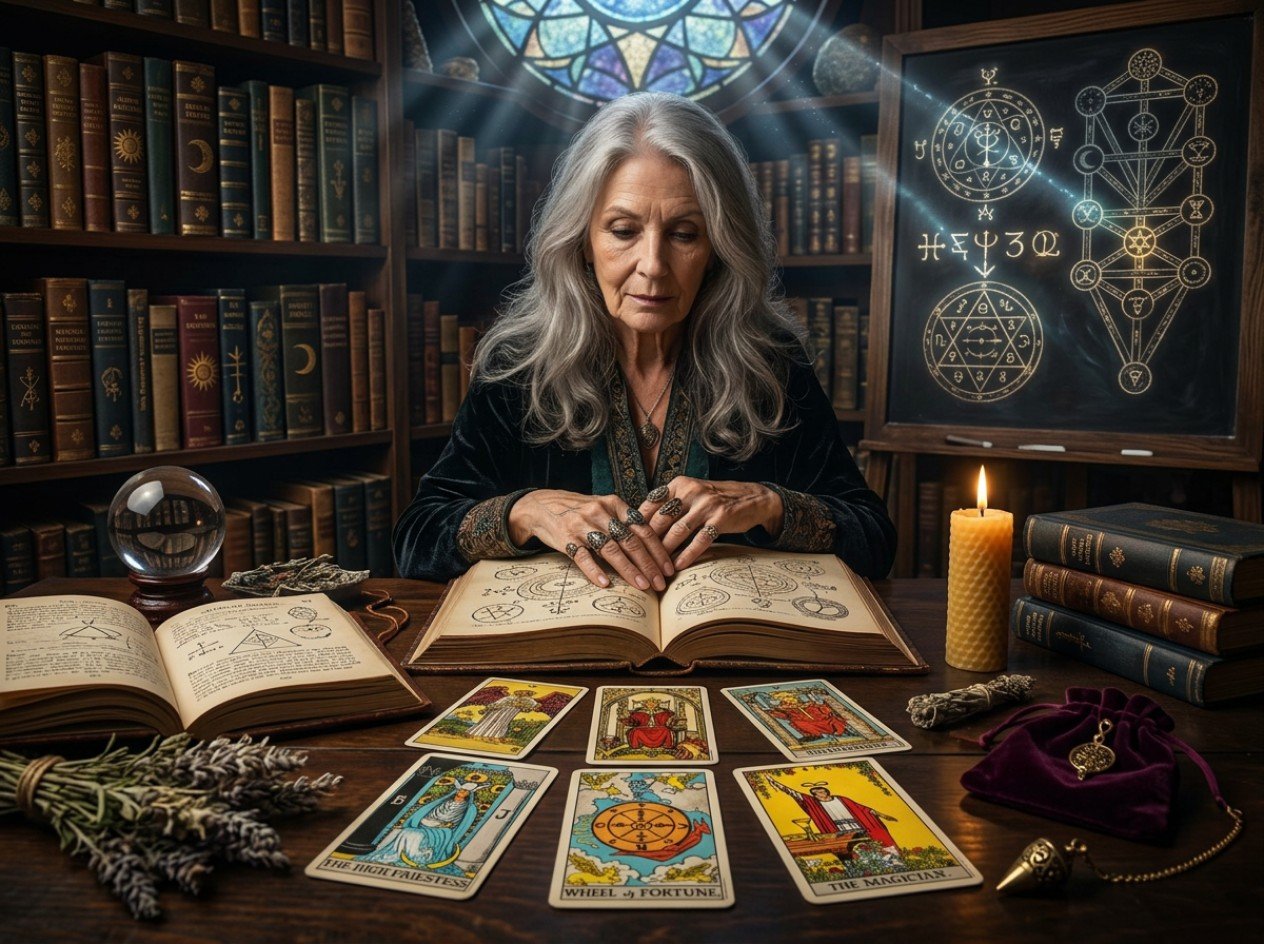
If you have ever examined a traditional Tarot deck, you will immediately notice its wealth of imagery. The Major Arcana alone contains figures such as The Fool, The Hermit, The High Priestess, Death, Temperance, The Star, and The World. These are not merely decorative illustrations. Each represents ideas that recur throughout mythology, religion, literature, and psychology. They explore themes such as innocence, wisdom, sacrifice, transformation, balance, hope, and fulfilment. In this sense, the Tarot speaks the language of symbolism, which has always been central to mystical traditions.
One reason symbolism is so important within mysticism is that many spiritual experiences are difficult to describe using ordinary language. Consider concepts such as enlightenment, transcendence, or the search for meaning. These are not easily reduced to simple definitions. Symbols allow us to approach complex ideas indirectly. A journey may represent personal growth. A mountain may symbolise spiritual aspiration. A lantern may represent wisdom. The Tarot provides a visual collection of such symbols, inviting contemplation rather than straightforward explanation.
This symbolic approach resonates strongly with the work of the Swiss psychiatrist Carl Jung. Although Jung was not a Tarot scholar in the traditional sense, his theories help explain why many people find the cards psychologically meaningful. Jung proposed that humanity shares certain universal symbolic patterns, which he referred to as archetypes. Figures such as the Hero, the Wise Old Man, the Mother, the Trickster, and the Shadow appear repeatedly in myths, dreams, religious traditions, and literature across cultures. Many of these archetypal themes also appear within the Tarot, making the cards useful prompts for self-reflection.
Tarot As A Reflective Tool
It is worth emphasising that many contemporary practitioners use the Tarot primarily as a reflective tool rather than as a means of predicting the future. When someone draws a card such as The Hermit, the value often lies not in forecasting an event but in asking thoughtful questions. Where in my life would solitude be beneficial? What wisdom have I overlooked? Am I listening carefully enough to my own inner voice? The card encourages reflection rather than certainty.
This brings us to one of mysticism's central principles: self-knowledge. Across numerous mystical traditions, knowing oneself is regarded as an essential step toward greater spiritual understanding. The Tarot supports this process because it encourages honest examination of our motivations, fears, hopes, and aspirations. Rather than providing ready-made answers, it frequently asks better questions. In educational terms, one might say that the Tarot functions less like an answer key and more like a discussion prompt.
The relationship between Tarot and mysticism also extends into ritual. Human beings have always used ritual to create moments of intention and reflection. Lighting a candle before meditation, keeping a gratitude journal, observing the phases of the Moon, or drawing a Tarot card before beginning a period of contemplation all represent ways of slowing down and focusing attention. The ritual itself is not magical in a mechanical sense. Its value lies in creating the psychological and emotional space needed for thoughtful reflection.
Another interesting connection involves narrative. Each Tarot reading tells a story, whether involving one card or several. Stories have always been powerful teaching tools because they allow us to examine ideas indirectly. Myths, religious parables, novels, and films all help us understand human behaviour through narrative. The Tarot operates similarly. A spread of cards encourages individuals to consider how different aspects of their lives interact, much as characters interact within a novel. Mysticism likewise often employs stories and parables to illuminate spiritual truths.
Students frequently ask whether one must believe in supernatural forces in order to appreciate the Tarot. The answer is no. Many psychologists, counsellors, artists, writers, and educators use symbolic exercises without making supernatural claims. A Tarot reading can be understood as an imaginative framework that stimulates reflection and creative thinking. Others, of course, approach the cards from explicitly spiritual perspectives. Both approaches recognise the importance of symbolism while differing in how they interpret its origins and significance.
Tarot's Symbols & Mysticism
The Tarot also demonstrates how mysticism often overlaps with other symbolic systems. Many decks incorporate astrological correspondences, elemental symbolism, numerology, Kabbalistic ideas, and mythological imagery. These connections illustrate the rich interdisciplinary nature of Western esoteric traditions. Rather than existing in isolation, different symbolic systems frequently inform one another, creating multiple perspectives through which individuals can explore meaning.
It is equally important, however, to approach the Tarot critically and historically. Some popular claims regarding its origins—for example, that it descends directly from ancient Egypt or contains secret wisdom from Atlantis—lack convincing historical evidence. Appreciating the genuine history of the Tarot does not diminish its symbolic value. Indeed, recognising how its meanings evolved over time allows us to appreciate the creativity with which different generations have interpreted the cards.
Perhaps the greatest contribution of the Tarot to mysticism lies in its encouragement of curiosity. Every card invites interpretation, every symbol raises questions, and every reading becomes an opportunity for reflection. Unlike systems that present fixed answers, the Tarot encourages dialogue. Two thoughtful readers may notice entirely different aspects of the same image, and both observations may enrich understanding. This openness reflects the spirit of much mystical inquiry, where exploration often matters more than certainty.
As both students and scholars, we should remember that symbols derive much of their power from the meanings we bring to them. A card cannot think on our behalf, nor can it replace careful judgement or ethical decision-making. What it can do is encourage us to pause, reflect, and examine situations from perspectives we might otherwise overlook. Used in this way, the Tarot becomes an educational tool as much as a mystical one.
Ultimately, the relationship between mysticism and the Tarot is founded upon a shared interest in human transformation. Both encourage us to explore questions of identity, purpose, morality, and personal growth. Both rely heavily upon symbolism rather than literal instruction. Both invite us to cultivate greater self-awareness and to approach life's mysteries with curiosity rather than fear. Whether one views the Tarot as a spiritual instrument, a psychological aid, or a fascinating cultural artefact, its enduring appeal lies in its ability to provoke reflection. That, I would suggest, is precisely where it finds its most meaningful connection with the wider traditions of mysticism.