


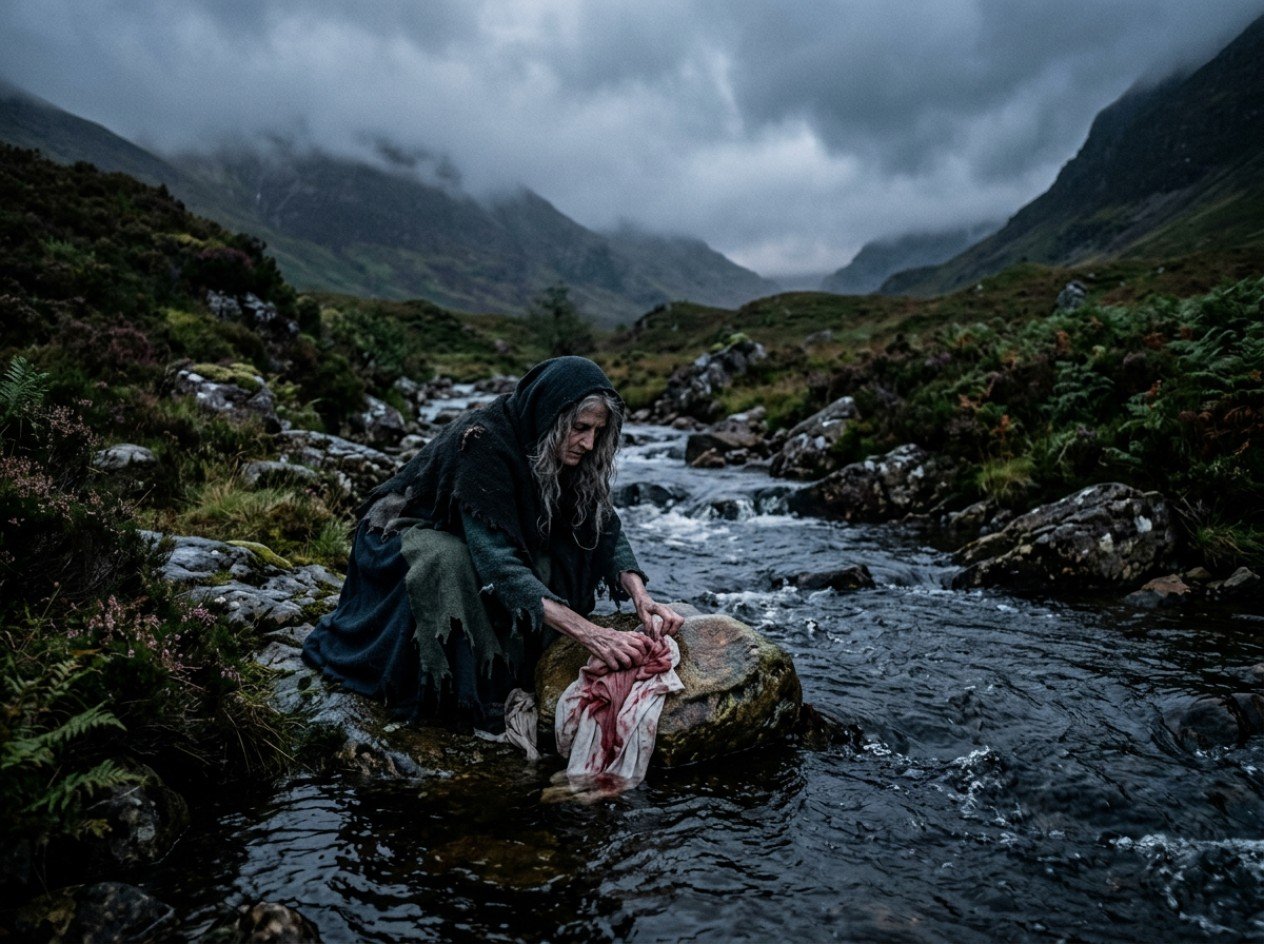
The Scottish Legend of the Bean-Nighe
She appears at the edge of the stream, usually at dusk or before dawn, washing clothes that are stained with blood. She is small, sometimes described as wizened and ancient, sometimes as a young woman with red, sometimes webbed feet. If you can get behind her and catch her before she sees you, you can compel her to answer three questions and grant you three wishes. If she sees you first, you will die. She is the bean-nighe, the Gaelic washerwoman at the ford, and she is, in my estimation, one of the most psychologically and ritually significant figures in the Celtic tradition, not despite the fact that most people find her terrifying, but precisely because of it.
I want to spend some time with her today, partly because she appeared briefly in my piece on Scottish rituals that I wrote last month, and I felt then that she deserved more careful attention, and partly because she opens up one of the most consistently fascinating questions in comparative ritual studies: why do virtually all human cultures produce figures whose function is to announce, prepare for, or personify death, and why do those figures so consistently take the form of a female presence at a liminal threshold? The cross-cultural evidence for this pattern is so robust that it demands an explanation beyond the merely coincidental, and the explanations that comparative scholarship has produced are, I think, genuinely illuminating about the nature of death ritual itself.
Scottish Highland Supernatural Beings
The bean-nighe belongs to the broader category of Scottish Highland supernatural beings sometimes grouped under the term sìth, the fairy folk, though that English translation loses almost everything important about what the Gaelic term actually means. The sìth are not charming diminutive creatures from a children's story. They are the presences of the other world, an saol eile, and their relationship to human beings is one of structured danger requiring ritual management rather than sentimental affection. The bean-nighe specifically is associated with the moment of death's approach, not death itself, but the period of preparation and transition that precedes it. She washes the shroud, or the battle garments, or sometimes simply the bloodied clothing of the person who is about to die. She is not causing the death. She is preparing for it. This distinction matters enormously from an anthropological standpoint, because it places her in the category of what I would call the ritual functionary of threshold: not the agent of transformation but the one who maintains the proper ritual conditions for the transformation to occur.
The ford where she appears is not a randomly chosen setting. Fords, the crossing points in rivers and streams, are among the most consistently significant liminal sites in Indo-European and Gaelic tradition. They are places where territory changes, where one kind of land gives way to another, where the boundary between the familiar and the unknown is physically enacted in the geography of crossing. To ford a river is to undergo a minor but structurally real transformation: you are not the same person on the far bank as you were on the near bank, in the sense that matters ritually, you have crossed. The ford is therefore the appropriate place for the washing that prepares the crossing, just as the threshold of a house is the appropriate place for the threshold blessings that protect the household from what lies beyond it, just as the graveside is the appropriate place for the rituals that seal the passage from life to death. Place and ritual are not separable in this tradition. The bean-nighe is at the ford because that is where the work of preparation must be done.
The Bean-Nighe In Other Cultures
Now let me turn to the comparative question, because this is where the material becomes genuinely extraordinary. The bean-nighe is a member of a class of figures that appears across human cultures with a frequency and structural consistency that I find one of the most compelling pieces of evidence for the universality of certain ritual concerns. Consider the Irish banshee, bean sídhe in Gaelic, the woman of the fairy mound, whose wailing announces the death of someone from one of the old Irish families. The banshee does not cause the death either. She mourns it in advance. She is the grief that precedes the event, which is a psychologically acute piece of ritual recognition: the process of loss begins before the loss itself, and someone needs to hold that anticipatory grief ritually.
Move across Europe to the Norse tradition and you find the Valkyries, female figures who appear at the battlefield to receive the souls of the dead and conduct them to Valhalla. The Valkyrie is not primarily the armoured warrior-maiden of popular imagination; she is, at her ritual core, the feminine psychopomp, the guide of souls through the threshold of death. She chooses who dies, which gives her a terrifying agency, but her deeper function is transitional: she conducts, she accompanies, she delivers. The structural similarity to the bean-nighe is not coincidental. Both are feminine presences who mediate the passage between the living world and the world of the dead.
Move further east and the pattern continues. In Slavic tradition, the Rusalki are female water spirits, again, water; again, the liminal medium, who are the spirits of young women who died before their time, and who are associated with both the danger of the spring flooding season and the fertility of the land. They are beautiful and they are deadly. In Japanese tradition, the yūrei are the restless dead, but the most feared among them, the onryō, the vengeful spirit, typically takes the form of a woman in white, her hair unbound and covering her face, appearing at the threshold between worlds to announce or cause harm. In Hindu tradition, Kali stands at the cremation ground, garlanded with skulls, her tongue extended in the posture of insatiable consumption, and she is simultaneously the most terrifying and the most liberating figure in the pantheon, the one who destroys what must be destroyed so that what must live can live.
The Bean-Nighe & Death
The question that comparative ritual studies keeps returning to is why this pattern is so consistent. Why is the figure who mediates death so frequently, across such geographically and culturally diverse traditions, female? Several answers have been proposed. The most straightforward is biological: women are associated with birth, with the bringing of life into the world, and the symmetry of associating them with death, the taking of life back, is a natural symbolic logic. A more sophisticated answer comes from the anthropological literature on gender and liminality: in many traditional societies, women occupy a structurally liminal position in the social order, neither fully of the domestic world nor fully of the public one, moving between categories rather than being fixed within them, which makes the feminine a natural symbolic resource for expressing and managing liminality in general, including the most extreme liminality of death. A third answer, which I find the most compelling, comes from the depth psychology tradition i.e., the anima as Jung understood it, the feminine principle within the psyche, is the guide to the unconscious, the figure who accompanies the ego into the depths of the self that daylight consciousness cannot access. Death, in this reading, is the ultimate depth, and the feminine psychopomp is the expression of the psyche's recognition that going there requires a guide who is native to those waters.
What the bean-nighe offers, when you sit with her carefully rather than simply registering her as frightening, is a very precise and very practical teaching about death's approach. She does not appear to the healthy and the vigorous going about their ordinary business. She appears at the threshold, in the liminal time, at the liminal place, to those whose crossing is imminent. And she is working. She is not lamenting. She is not predicting. She is preparing. There is something in that, in the image of the small, dark woman at the ford, washing in the cold water before dawn, that I find more honest about death than almost anything the modern world has produced. Death requires preparation. The preparation is ritual work. Somebody has to do it. The bean-nighe has been doing it, in the Highland imagination, for a very long time.